
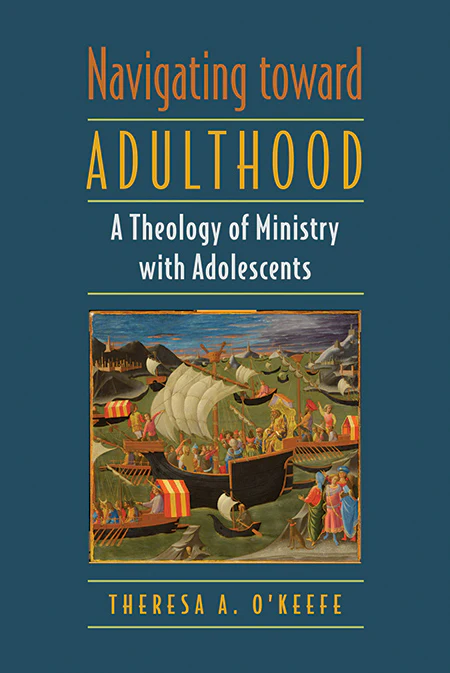
Navigating Toward Adulthood: A Theology of Ministry with Adolescents
The theological and ministerial task at the heart of ministry with adolescents is assisting adolescents to recognize and grow into the multiple relationships in their lives, including their relationship with God. The author divides her work into four parts. In Part I, she establishes the book’s argument, namely that the project of adolescence—the growth from childhood to adulthood—is to find one’s place in the world and involves multiple relational and interpretive tasks. In Part II, she argues for the social nature of adulthood, offering, first, a definition of adulthood as being responsible within the context of relationships. Thus, adolescence is the time to learn to be responsible within the context of relationships.
In Part III, the author names adolescence as the optimal life stage for the transformation from an instrumental to a relational engagement with the world. In Part IV, she considers the church’s response. She focuses on how Christian narratives, embodied in the lives of real people, communicate a horizon upon which adolescents may interpret their lives. And she closes with the suggestion that robust relationships and relational practices support the development of the relational and interpretive tasks of adolescence. Throughout the inquiry is a theological argument identifying the constant presence and movement of God’s grace in the transformation of adolescents.
Navigating Toward Adulthood: A Theology of Ministry with Adolescents
The theological and ministerial task at the heart of ministry with adolescents is assisting adolescents to recognize and grow into the multiple relationships in their lives, including their relationship with God. The author divides her work into four parts. In Part I, she establishes the book’s argument, namely that the project of adolescence—the growth from childhood to adulthood—is to find one’s place in the world and involves multiple relational and interpretive tasks. In Part II, she argues for the social nature of adulthood, offering, first, a definition of adulthood as being responsible within the context of relationships. Thus, adolescence is the time to learn to be responsible within the context of relationships.
In Part III, the author names adolescence as the optimal life stage for the transformation from an instrumental to a relational engagement with the world. In Part IV, she considers the church’s response. She focuses on how Christian narratives, embodied in the lives of real people, communicate a horizon upon which adolescents may interpret their lives. And she closes with the suggestion that robust relationships and relational practices support the development of the relational and interpretive tasks of adolescence. Throughout the inquiry is a theological argument identifying the constant presence and movement of God’s grace in the transformation of adolescents.
Product Information
Product Information
Shipping & Returns
Shipping & Returns
Description
The theological and ministerial task at the heart of ministry with adolescents is assisting adolescents to recognize and grow into the multiple relationships in their lives, including their relationship with God. The author divides her work into four parts. In Part I, she establishes the book’s argument, namely that the project of adolescence—the growth from childhood to adulthood—is to find one’s place in the world and involves multiple relational and interpretive tasks. In Part II, she argues for the social nature of adulthood, offering, first, a definition of adulthood as being responsible within the context of relationships. Thus, adolescence is the time to learn to be responsible within the context of relationships.
In Part III, the author names adolescence as the optimal life stage for the transformation from an instrumental to a relational engagement with the world. In Part IV, she considers the church’s response. She focuses on how Christian narratives, embodied in the lives of real people, communicate a horizon upon which adolescents may interpret their lives. And she closes with the suggestion that robust relationships and relational practices support the development of the relational and interpretive tasks of adolescence. Throughout the inquiry is a theological argument identifying the constant presence and movement of God’s grace in the transformation of adolescents.