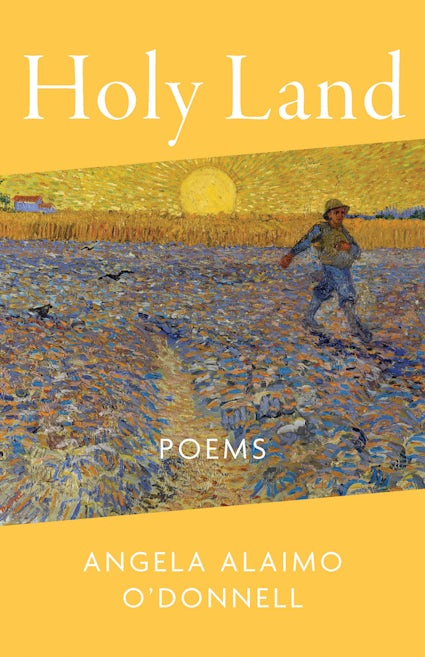
Holy Land
“Remove your sandals from your feet, for the place on which you are standing is holy ground." —Exodus 3:5
“The Holy Land is everywhere.” —Black Elk
The two epigraphs that preface Angela Alaimo O’Donnell’s Holy Land introduce the reader to the central theme that permeates her poems: that holy places deserve to be regarded with reverence and that all places are holy places. In her afterward, the poet traces these foundational concepts to her Catholic childhood wherein religious instruction consisted largely of memorizing the Baltimore Catechism. “One of questions the Catechism poses is ‘Where is God?’ The answer is ‘God is everywhere.’ We believed this to be true. God was in church, but God was also in our house (a crucifix in every room), in the backyard, in our Buick (rosary beads swinging from the rearview mirror), at our birthday parties in the basement, and in our own bodies. And though those places may not sound very holy, they were. Because God was there. Is there.”
In addition to affirming this foundational belief, these poems extend the terrain, moving beyond the geographical and the physical to the temporal, the carnal, the intellectual, and the spiritual realms. They assert that our days are blessed, our bodies are blessed, our minds and souls are all blessed and sacred ground. The poet explores a broad spectrum of physical locations, beginning with poems set in the Holy Land and moving on to places closer to home, ranging from the west of Ireland to rural Minnesota, from New York City to the Texas border. She also probes the temporal spaces we occupy, experiences of death and birth, love and loss, desire and desolation that mark our human passage.
The English word holy is related to the Germanic word heilig, a word that means blessed and also carries within it the idea of wholeness. Holy Land attempts to honor both the holiness and the wholeness of our world—from Gotham to Golgotha, the Bronx River to the Sea of Galilee—and to honor the holiness and wholeness of our blessed and broken humanity.
Original: $21.53
-65%$21.53
$7.54Holy Land
“Remove your sandals from your feet, for the place on which you are standing is holy ground." —Exodus 3:5
“The Holy Land is everywhere.” —Black Elk
The two epigraphs that preface Angela Alaimo O’Donnell’s Holy Land introduce the reader to the central theme that permeates her poems: that holy places deserve to be regarded with reverence and that all places are holy places. In her afterward, the poet traces these foundational concepts to her Catholic childhood wherein religious instruction consisted largely of memorizing the Baltimore Catechism. “One of questions the Catechism poses is ‘Where is God?’ The answer is ‘God is everywhere.’ We believed this to be true. God was in church, but God was also in our house (a crucifix in every room), in the backyard, in our Buick (rosary beads swinging from the rearview mirror), at our birthday parties in the basement, and in our own bodies. And though those places may not sound very holy, they were. Because God was there. Is there.”
In addition to affirming this foundational belief, these poems extend the terrain, moving beyond the geographical and the physical to the temporal, the carnal, the intellectual, and the spiritual realms. They assert that our days are blessed, our bodies are blessed, our minds and souls are all blessed and sacred ground. The poet explores a broad spectrum of physical locations, beginning with poems set in the Holy Land and moving on to places closer to home, ranging from the west of Ireland to rural Minnesota, from New York City to the Texas border. She also probes the temporal spaces we occupy, experiences of death and birth, love and loss, desire and desolation that mark our human passage.
The English word holy is related to the Germanic word heilig, a word that means blessed and also carries within it the idea of wholeness. Holy Land attempts to honor both the holiness and the wholeness of our world—from Gotham to Golgotha, the Bronx River to the Sea of Galilee—and to honor the holiness and wholeness of our blessed and broken humanity.
Product Information
Product Information
Shipping & Returns
Shipping & Returns
Description
“Remove your sandals from your feet, for the place on which you are standing is holy ground." —Exodus 3:5
“The Holy Land is everywhere.” —Black Elk
The two epigraphs that preface Angela Alaimo O’Donnell’s Holy Land introduce the reader to the central theme that permeates her poems: that holy places deserve to be regarded with reverence and that all places are holy places. In her afterward, the poet traces these foundational concepts to her Catholic childhood wherein religious instruction consisted largely of memorizing the Baltimore Catechism. “One of questions the Catechism poses is ‘Where is God?’ The answer is ‘God is everywhere.’ We believed this to be true. God was in church, but God was also in our house (a crucifix in every room), in the backyard, in our Buick (rosary beads swinging from the rearview mirror), at our birthday parties in the basement, and in our own bodies. And though those places may not sound very holy, they were. Because God was there. Is there.”
In addition to affirming this foundational belief, these poems extend the terrain, moving beyond the geographical and the physical to the temporal, the carnal, the intellectual, and the spiritual realms. They assert that our days are blessed, our bodies are blessed, our minds and souls are all blessed and sacred ground. The poet explores a broad spectrum of physical locations, beginning with poems set in the Holy Land and moving on to places closer to home, ranging from the west of Ireland to rural Minnesota, from New York City to the Texas border. She also probes the temporal spaces we occupy, experiences of death and birth, love and loss, desire and desolation that mark our human passage.
The English word holy is related to the Germanic word heilig, a word that means blessed and also carries within it the idea of wholeness. Holy Land attempts to honor both the holiness and the wholeness of our world—from Gotham to Golgotha, the Bronx River to the Sea of Galilee—and to honor the holiness and wholeness of our blessed and broken humanity.