🚚 Free Worldwide Shipping on All Orders!Shop Now

HomeStore
Functional Anatomy of the Pilates Core: An Illustrated Guide to a Safe and Effective Core Training Program
Functional Anatomy of the Pilates Core: An Illustrated Guide to a Safe and Effective Core Training Program
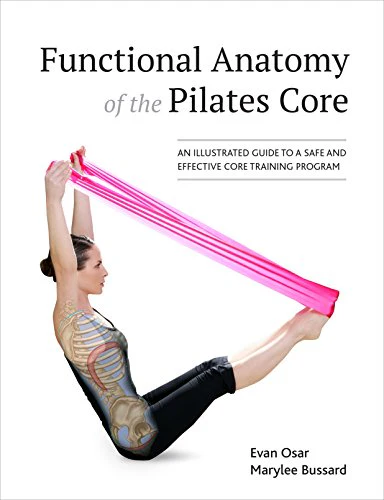
This book is the first to illustrate the essential connection between the functional anatomy of the body’s core and its application during Pilates’ fundamental core exercises. Focusing on the inherent potential of the human body to stabilize and move, Dr. Evan Osar and Marylee Bussard combine the most current research around core stabilization with six fundamental Pilates principles to offer simple, easy-to-use strategies for relieving discomfort and improving pain-free movement. With more than 290 full-color illustrations, Functional Anatomy of the Pilates Core provides both Pilates practitioners and professional teachers with a comprehensive understanding of how the core functions and how stabilization helps promote health and proper movement patterns through the development of balanced muscles, joint alignment, and core control.
The authors apply current research on neuroplasticity, the brain's capacity to reorganize itself by developing new neuronal connections, and on the function of fascia, the matrix-like connective tissue of the body, to explain the six fundamental principles of Pilates—Centering, Concentration, Control, Precision, Breath, and Flow. They show how to avoid muscle imbalances, chronic tightness, and pain by incorporating the principles of functional anatomy during exercise.
Readers learn how to:
• Achieve the alignment, breathing, and control required for developing optimal posture and movement
• Alleviate non-optimal habits that relate to common postural dysfunction, muscle imbalances, and chronic tightness
• Integrate the fundamental Pilates exercises in order to develop a more stable core and eliminate the risks of common injuries while accomplishing one’s health and fitness goals
From the Trade Paperback edition.
The authors apply current research on neuroplasticity, the brain's capacity to reorganize itself by developing new neuronal connections, and on the function of fascia, the matrix-like connective tissue of the body, to explain the six fundamental principles of Pilates—Centering, Concentration, Control, Precision, Breath, and Flow. They show how to avoid muscle imbalances, chronic tightness, and pain by incorporating the principles of functional anatomy during exercise.
Readers learn how to:
• Achieve the alignment, breathing, and control required for developing optimal posture and movement
• Alleviate non-optimal habits that relate to common postural dysfunction, muscle imbalances, and chronic tightness
• Integrate the fundamental Pilates exercises in order to develop a more stable core and eliminate the risks of common injuries while accomplishing one’s health and fitness goals
From the Trade Paperback edition.
$9.95
Original: $28.43
-65%Functional Anatomy of the Pilates Core: An Illustrated Guide to a Safe and Effective Core Training Program—
$28.43
$9.95Functional Anatomy of the Pilates Core: An Illustrated Guide to a Safe and Effective Core Training Program
This book is the first to illustrate the essential connection between the functional anatomy of the body’s core and its application during Pilates’ fundamental core exercises. Focusing on the inherent potential of the human body to stabilize and move, Dr. Evan Osar and Marylee Bussard combine the most current research around core stabilization with six fundamental Pilates principles to offer simple, easy-to-use strategies for relieving discomfort and improving pain-free movement. With more than 290 full-color illustrations, Functional Anatomy of the Pilates Core provides both Pilates practitioners and professional teachers with a comprehensive understanding of how the core functions and how stabilization helps promote health and proper movement patterns through the development of balanced muscles, joint alignment, and core control.
The authors apply current research on neuroplasticity, the brain's capacity to reorganize itself by developing new neuronal connections, and on the function of fascia, the matrix-like connective tissue of the body, to explain the six fundamental principles of Pilates—Centering, Concentration, Control, Precision, Breath, and Flow. They show how to avoid muscle imbalances, chronic tightness, and pain by incorporating the principles of functional anatomy during exercise.
Readers learn how to:
• Achieve the alignment, breathing, and control required for developing optimal posture and movement
• Alleviate non-optimal habits that relate to common postural dysfunction, muscle imbalances, and chronic tightness
• Integrate the fundamental Pilates exercises in order to develop a more stable core and eliminate the risks of common injuries while accomplishing one’s health and fitness goals
From the Trade Paperback edition.
The authors apply current research on neuroplasticity, the brain's capacity to reorganize itself by developing new neuronal connections, and on the function of fascia, the matrix-like connective tissue of the body, to explain the six fundamental principles of Pilates—Centering, Concentration, Control, Precision, Breath, and Flow. They show how to avoid muscle imbalances, chronic tightness, and pain by incorporating the principles of functional anatomy during exercise.
Readers learn how to:
• Achieve the alignment, breathing, and control required for developing optimal posture and movement
• Alleviate non-optimal habits that relate to common postural dysfunction, muscle imbalances, and chronic tightness
• Integrate the fundamental Pilates exercises in order to develop a more stable core and eliminate the risks of common injuries while accomplishing one’s health and fitness goals
From the Trade Paperback edition.
Product Information
Product Information
Shipping & Returns
Shipping & Returns
Description
This book is the first to illustrate the essential connection between the functional anatomy of the body’s core and its application during Pilates’ fundamental core exercises. Focusing on the inherent potential of the human body to stabilize and move, Dr. Evan Osar and Marylee Bussard combine the most current research around core stabilization with six fundamental Pilates principles to offer simple, easy-to-use strategies for relieving discomfort and improving pain-free movement. With more than 290 full-color illustrations, Functional Anatomy of the Pilates Core provides both Pilates practitioners and professional teachers with a comprehensive understanding of how the core functions and how stabilization helps promote health and proper movement patterns through the development of balanced muscles, joint alignment, and core control.
The authors apply current research on neuroplasticity, the brain's capacity to reorganize itself by developing new neuronal connections, and on the function of fascia, the matrix-like connective tissue of the body, to explain the six fundamental principles of Pilates—Centering, Concentration, Control, Precision, Breath, and Flow. They show how to avoid muscle imbalances, chronic tightness, and pain by incorporating the principles of functional anatomy during exercise.
Readers learn how to:
• Achieve the alignment, breathing, and control required for developing optimal posture and movement
• Alleviate non-optimal habits that relate to common postural dysfunction, muscle imbalances, and chronic tightness
• Integrate the fundamental Pilates exercises in order to develop a more stable core and eliminate the risks of common injuries while accomplishing one’s health and fitness goals
From the Trade Paperback edition.
The authors apply current research on neuroplasticity, the brain's capacity to reorganize itself by developing new neuronal connections, and on the function of fascia, the matrix-like connective tissue of the body, to explain the six fundamental principles of Pilates—Centering, Concentration, Control, Precision, Breath, and Flow. They show how to avoid muscle imbalances, chronic tightness, and pain by incorporating the principles of functional anatomy during exercise.
Readers learn how to:
• Achieve the alignment, breathing, and control required for developing optimal posture and movement
• Alleviate non-optimal habits that relate to common postural dysfunction, muscle imbalances, and chronic tightness
• Integrate the fundamental Pilates exercises in order to develop a more stable core and eliminate the risks of common injuries while accomplishing one’s health and fitness goals
From the Trade Paperback edition.